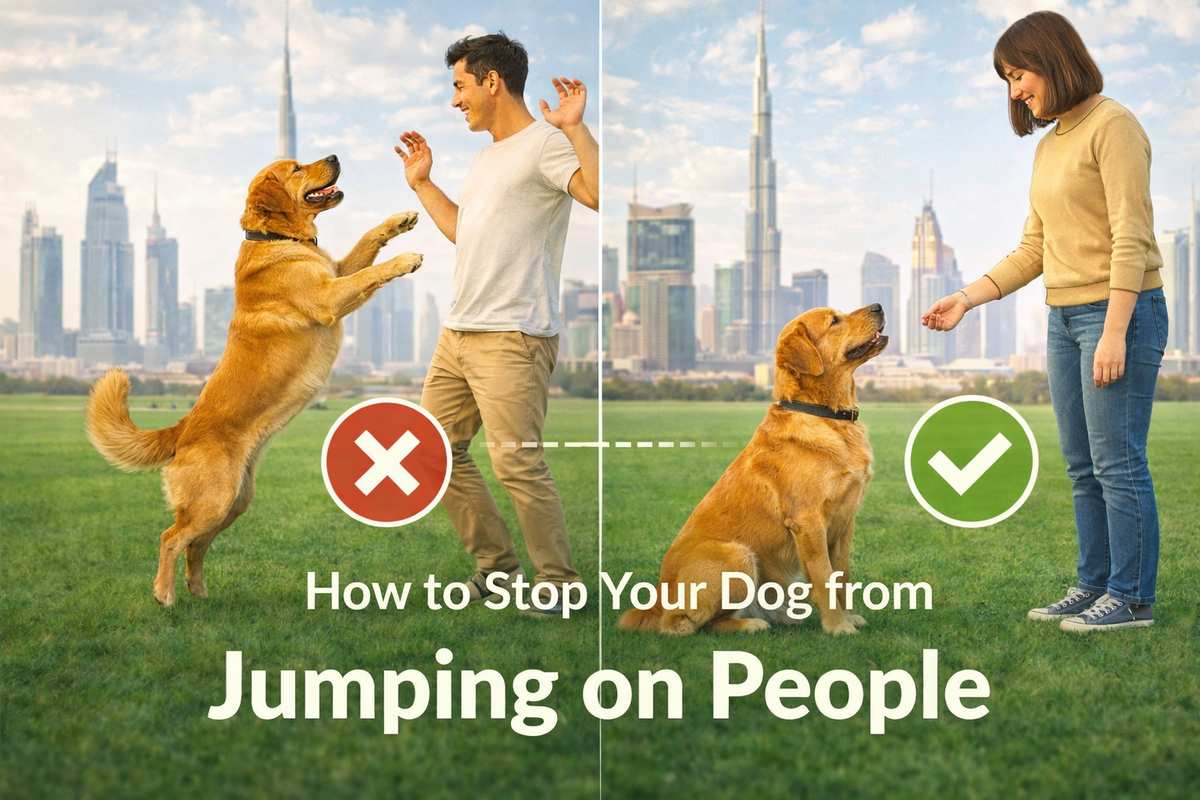
How to Stop Your Dog from Jumping on People
Learn how to stop your dog from jumping on people using simple, effective training methods that build calm behaviour and control.
Dog jumping on people is one of the most common complaints from dog owners — and one of the most misunderstood.
While it may seem harmless at first, jumping quickly becomes a problem. It can lead to overexcitement, loss of control, and even reactivity if not addressed early.
The good news is that jumping is not a personality trait. It’s a learned behaviour — which means it can be changed with the right approach.
This guide explains why dogs jump, what most owners get wrong, and exactly how to fix it properly.
Why Dogs Jump on People
Dogs jump for one main reason: it works.
Jumping gets:
- Attention
- Eye contact
- Touch
- Interaction
Even negative reactions like pushing the dog away or saying “no” still reinforce the behaviour.
From the dog’s perspective, jumping is a successful strategy.
Not All Jumping Is the Same
Understanding the type of jumping matters.
Excitement-Based Jumping
- Happens during greetings
- Usually with familiar people
- Driven by energy and lack of impulse control
Attention-Seeking Jumping
- Happens when the dog wants interaction
- Often persistent
- Reinforced by inconsistent responses
Overstimulation Jumping
- Dog cannot regulate excitement
- Often paired with barking or mouthing
- Common in social or outdoor environments
Anxiety-Driven Jumping
- Dog jumps due to uncertainty or insecurity
- Often combined with clingy behaviour
Each type requires slightly different management, but the foundation of training remains the same.
Why Ignoring the Problem Makes It Worse
Jumping rarely stays “just jumping.”
If not addressed, it often escalates into:
- Leash pulling
- Barking at people
- Loss of control in public
- Reactivity toward dogs or strangers
This happens because the dog never learns how to regulate excitement.
Common Mistakes Owners Make
Most jumping problems are unintentionally reinforced.
The most common mistakes include:
- Saying “no” but still giving attention
- Pushing the dog away (physical contact reinforces behaviour)
- Allowing jumping sometimes but not always
- Guests interacting with the dog inconsistently
- Trying to correct behaviour without teaching an alternative
Inconsistency is the fastest way to make the behaviour stronger.
Step-by-Step: How to Stop Your Dog from Jumping
This is where most blogs fail — they give advice without a system.
Here is the correct structure to follow.
Step 1: Remove All Reinforcement
Jumping must stop working completely.
That means:
- No eye contact
- No talking
- No touching
If the dog jumps, interaction stops immediately.
Consistency here is critical.
Step 2: Control the Environment
Set your dog up to succeed.
Before greetings:
- Keep the dog on a leash if needed
- Reduce excitement before interaction
- Avoid chaotic environments early on
Training fails when the environment is too stimulating too soon.
Step 3: Teach an Alternative Behaviour
You cannot remove a behaviour without replacing it.
The most effective replacement is:
👉 Sit for greeting
The rule becomes:
- Sitting = attention
- Jumping = nothing
Reward the dog immediately when all four paws are on the ground.
Step 4: Reinforce Calm Behaviour
Do not wait for perfection.
Reward:
- Calm approach
- Controlled movement
- Neutral behaviour
Dogs repeat what gets rewarded.
Step 5: Generalize the Behaviour
Your dog must learn this rule everywhere.
Practice with:
- Family members
- Guests
- Strangers
- Outdoor environments
If you only train at home, the behaviour will not transfer.
Real-Life Scenarios (How to Handle Them)
Dog Jumps on Guests
- Brief guests before they enter
- No interaction until the dog is calm
- Use leash control if needed
Dog Jumps on Strangers Outside
- Do not allow greetings until calm
- Create distance if the dog is too excited
- Reward calm observation instead of interaction
Dog Listens to You But Not Others
This means the behaviour is not fully trained — only context-specific.
Solution:
- Practice with different people
- Reinforce consistency across all interactions
When Jumping Becomes a Bigger Problem
Jumping can be a symptom of deeper issues.
Watch for:
- Inability to settle
- Excessive barking
- High reactivity
- Poor impulse control
In these cases, jumping is not the main problem — it’s a result of lack of structure.
When You Need Professional Help
You should consider structured training if:
- The behaviour is not improving
- Your dog becomes overly excited quickly
- Jumping is paired with barking or lunging
- You struggle to control your dog in public
These cases require structured guidance, not just basic training tips.
Final Thoughts
Dog jumping is not about disobedience.
It’s about:
- Reinforcement
- Consistency
- Emotional control
If jumping continues, it means the behaviour is still being rewarded somewhere.
Fixing it requires clarity, structure, and repetition.
FAQ: Dog Jumping on People
Why does my dog jump on guests but not me?
Because guests often respond differently and reinforce the behaviour.
Should I push my dog away when it jumps?
No. Physical interaction can reinforce the behaviour.
How long does it take to stop jumping?
With consistency, improvement can be seen quickly — but full reliability takes repetition across different environments.
Is jumping a sign of dominance?
No. It is usually excitement or learned behaviour.
Need Help With Your Dog’s Behaviour?
If your dog’s jumping is escalating or not improving, structured training can help correct the behaviour and build proper impulse control.
We work with dogs across Dubai and Abu Dhabi, focusing on real-world behaviour, socialization, and long-term results.
You Might Also Like
Positive Dog Training: How Positive Reinforcement Works and Why It’s Best
Learn how positive reinforcement dog training builds calm, reliable behaviour. D...
Read more
How to Find the Best Dog Behaviourist in the UAE
Searching for a dog behaviourist near you in Dubai or the UAE? Learn how to choo...
Read more
Separation Anxiety in Dogs: Signs, Causes and How to Help
Separation anxiety in dogs is one of the most misunderstood behavioral issues. I...
Read more
Why Your Dog Is Not Listening Even After Training
Your dog still doesn’t listen after training? Discover the real reasons why dog...
Read more